– Jennifer Nash
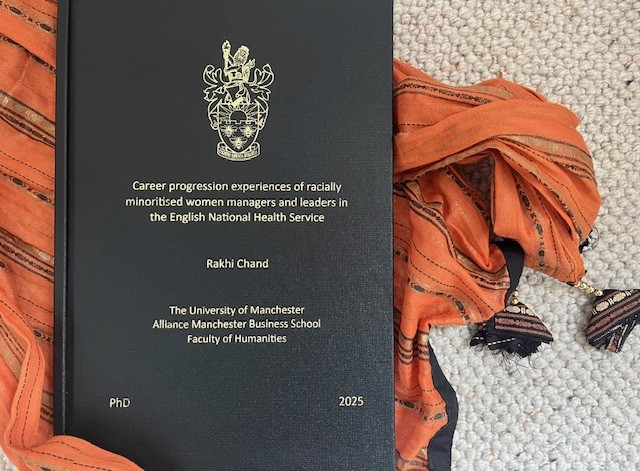
‘You know more about loss in your bones than any thesis could capture’, I wrote to my sister at the end of my PhD. In the last years of my research, the losses in my orbit were not ordinary, slow and quiet. Grief was hot. It is therefore no coincidence that loss became my research lens. Arguably, however, loss – in all its iterations – was always my backdrop: as a psychotherapist, I know that therapy in many ways is an education in loss.
During the PhD years – some five of them – my education in many (loss-adjacent) worlds spiced up. I read hungrily, for example, about Black feminism, decolonisation, whiteness and misogynoir. I got to thinking and feeling about women on the margins of the margins: various categories of racially minoritised women.
In the UK’s National Health Service (NHS), racially minoritised women comprise 21% of the workforce yet only 10% of senior leaders (NHS Digital 2024, Unpublished). Though this problem of underrepresentation is far from unique to healthcare, or indeed the UK, the scale of the problem is: the NHS is the world’s sixth largest employer. This was my research setting.
I interviewed fifteen diverse racially minoritised women leaders extensively to sense their career progression journeying within the NHS. Gendered racism, the mutually constitutive experience of racism and sexism, appeared common. Through the lens of ‘loss’, I waded through stories of heartbreak, body-break, break-outs and break-throughs. I too was nearly broken at times. And here I am, sharing some snippets.
One of my own break-throughs came from being ushered toward Jennifer Nash’s ridiculously stunning book, ‘How We Write Now’ (thanks to another stunner, my close colleague, Foluke Taylor). Nash, Black feminist and academic, writes of ‘the always-already-thereness of loss at various scales as constitutive of Black women’s lives’ (Nash 2024, p.4). Nash, like other influential Black feminists, treats the term ‘Black’ as a political and expansive category rather than a purely biological one. In an earlier paper, Nash (2019, p.103) defines loss
capaciously to capture absence, erasure, what is missed and missing, what is taken or stolen, what is unknown and unknowable. … loss […] signal[s] experiences of invisibility and dispossession, to capture institutional arrangements that render Black women unseen and disappeared, to describe persistent feelings of loneliness and alienation that are structurally produced, and to name Black feminist theory’s persistent attention to ghosts, to the palpable presence of the past in the present.
I found (research) home in pausing on these facets, or constellations, of loss since this framing recast my understanding of participants’ words. They gave me a vernacular to recognise and name certain experiences – experiences that were rarely (if ever) named as ‘loss’ by research participants or therapy clients. For instance, several participants described rarely experiencing social support at work. Absence, I thought: the first facet of loss described by Nash. I note that the size, shape and impacts of such social absences may be hard to grasp, speaking to unknown and unknowable losses. The consequences for the women (research participants) I spoke to were, however, undeniable: the absence of social networks meant limited access to power – including leadership opportunities.
Experiences of not being acknowledged or remembered, being unseen and unheard, were also reported. I was reminded of Nash’s loss lexicon as including invisibility and erasure. Participants’ distance to (male, white, able-bodied, cis and heterosexual) norms appeared related to such invisibility. A lack of social power followed: leadership positions were elusive for those tending to go unseen. Such invisibilisation is worryingly pervasive across fields: there is also limited research on the career experiences of various categories of racially minoritised women.
The field of psychotherapy is no exception in risking erasure of minoritised groups. It has long been shaped by white, western and often male perspectives; many of its institutions still reflect that legacy. One way that practitioners can and do work against that in the (research or therapy) room is by widening what they attend to. Legal scholar and activist Mari Matsuda’s influential method of ‘asking the other question’ helps to see the non-obvious and avoid erasure. In her words, when she sees something that looks racist, she asks, “Where is the patriarchy in this?”. When she sees something sexist, she asks, “Where is the heterosexism in this?”. The premise here is that no form of erasure stands alone – similar to Matsuda’s (1991, p. 1189) thinking that ‘no form of subordination ever stands alone’.
Whilst finding resonance in Matsuda’s neat formulation, yet more elusive – and at times more troubling – erasures haunted participants’ stories. Post-colonial writers (titans really, like Gayatri Spivak) helped me to name these. Epistemic erasures arose from racially minoritised women leaders tending not to be seen as ‘knowers’. Ontological erasures, instead, related to being perceived – consciously or not – as inherently inferior. An example of the latter could be policy makers not even imagining this group as policy subjects. Some participants reported that institutional policy makers did not, for example, conceive of the needs of racially minoritised women staff when deciding who might facilitate training to support career progression, much less separate staff groups by ‘race’ or gender for developmental discussions. Experiences of ontological erasure were especially familiar to Black women of all heritages and/or those born outside of the UK. I call such subtle, profound erasures ‘screaming silences’, adopting academic Laura Serrant-Green’s term. I am better equipped to hear such silences with therapy clients, taking care not to impose my awakening upon their narrative. They may really just want to talk about their mother.
Both kinds of profound erasure (epistemic and ontological) I consider inseparable from Britain’s slavery-trading, imperial and colonial histories and their lingering impacts. For instance, postcolonial legacies rendered some first-generation migrant participants deeply respected by senior figures, and still not recognised as leaders. Put another way, to be depended upon and simultaneously not fully trusted mirrors colonial patterns of racist discrimination. As Nash (2024, p.3) writes, these losses are lived where ‘intimate, political, or social scales intersect’. This, for me, is manifest in the therapy room: I am as interested in the systems of power at play as in tip-toeing around in a client’s very personal world. Furthermore, given that future possibilities for leadership also appeared erased for some participants, these losses are also lived where past, present and future scales intersect.
Novelist Toni Morrison called the serious function of racism to be distraction from the real work of living. I suggest in this context that gendered racism is a serious distraction from the real work of navigating one’s career. Though some participants had climbed to senior levels, occasionally with wonderful support, almost all reported not having achieved their potential. Some reported something akin to surviving their careers; losses of health abound. This is not to suggest victimhood, or to overlook all the living and leading (professionally and personally) done regardless. Neither do I mean to suggest that the lens of loss is everything. Though it has expanded my professional thinking and being recently, like all theories, I aim to hold it lightly lest it obscure other dimensions.
Research on workplace inequalities often ends with a list of recommendations. I couldn’t bear to follow suit given that decades of (important) recommendations have not led to the reduction of workplace inequalities. I did, however, find some resonance in a recent report by ‘brap’, a fairness and human rights charity, on racism in the NHS. The report urged for more empathy and less defensiveness from the organisation and its members: shifts in the affective domain. Similarly, my research suggests that the ‘conjoined twin’ of recommendations to address workplace inequalities is the gruelling affective work of gendered racism and other forms of discrimination. That is, ‘feeling the feels’ of the myriad losses encountered. Drawing on scholar and activist Sara Ahmed’s work, it is perhaps only through this affective labour that the ‘not yet’ of leadership—and of more liveable working worlds—can begin to emerge.
A version of this article was originally published by the British Association for Counselling and Psychotherapy: https://tinyurl.com/yck245h9
References
Ahmed, S. (2002) ‘This other and other others’, Economy and Society, 31(4), pp. 558–572. Available at: https://doi.org/10.1080/03085140022000020689.
Bhabha, H. (1982). The other question. [Online]. Available from: https://www.librarysearch.manchester.ac.uk/discovery/fulldisplay/cdi_scopus_primary_2_s2_0_77958400524/44MAN_INST:MU_NUI
Matsuda, M.J. (1991) ‘Beside My Sister, Facing the Enemy: Legal Theory out of Coalition’, Stanford Law Review, 43(6), p. 1183. Available at: https://doi.org/10.2307/1229035.
Morrison, T. (1975). A Humanist View. Portland State University.
Nash, J.C. (2024). How We Write Now: Living with Black Feminist Theory. US: Duke University Press. [Online]. Available from: https://gendersexualityfeminist.duke.edu/books/how-we-write-now-living-black-feminist-theory
Nash, J.C. (2019). Writing Black Beauty. Signs: Journal of Women in Culture and Society, 45(1), pp.101–122. [online].
NHS Digital. (2024). NHS Hospital and Community Health Services (HCHS) staff by staff group, grade, gender and ethnicity, in NHS Trusts and other core organisations in England, as at the last day of the month, March 2023 to September 2024, headcount. [Unpublished]
Richardson, K. (2023). Exclusion and Erasure: Two Types of Ontological Oppression. Ergo an Open Access Journal of Philosophy, 9(0). [Online].
Serrant-Green, L. (2011). The sound of ‘silence’: a framework for researching sensitive issues or marginalised perspectives in health. Journal of Research in Nursing, 16(4), pp.347–360. [online].
Spivak, G.C. (1988). Can the Subaltern Speak? In Colonial Discourse and Post-Colonial Theory. London, UK: Routledge.
Taylor, F. and Downes, R. (2021). Re-imagining the space and context for a therapeutic curriculum. In Black Identities + White Therapies: Race, Respect + Diversity. UK: PCCS Books. [online]. Available from: https://www.pccs-books.co.uk/products/black-identites-and-white-therapies.
Warmington, J., Kline, R. and Somra, G. (2024). Too Hot to Handle? [online]. Available from: https://www.brap.org.uk/post/toohottohandle